

Diagnosed,
Interactive Documentary
Overview
Diagnosed is a collection of true stories from one family told through the moments when their neurodiversity shaped their lives. A boy who struggles with transition and grows up to study quantum physics on the other side of the world. A brother whose mania, along with his incredible kindness, generosity, creativity, intellect and many more exceptionally beautiful traits and virtue allowed him to light up every room, which was a times blurred the line by some people of faith between the Holy Spirit’s inspiration and a manic episode, not knowing he needed a hospital in that moment, not only a prayer session. A mother that built an ambitious, ecletic and eventually prestigious career with a restless that kept her working past midnight on most nights for decades until her body collapsed.
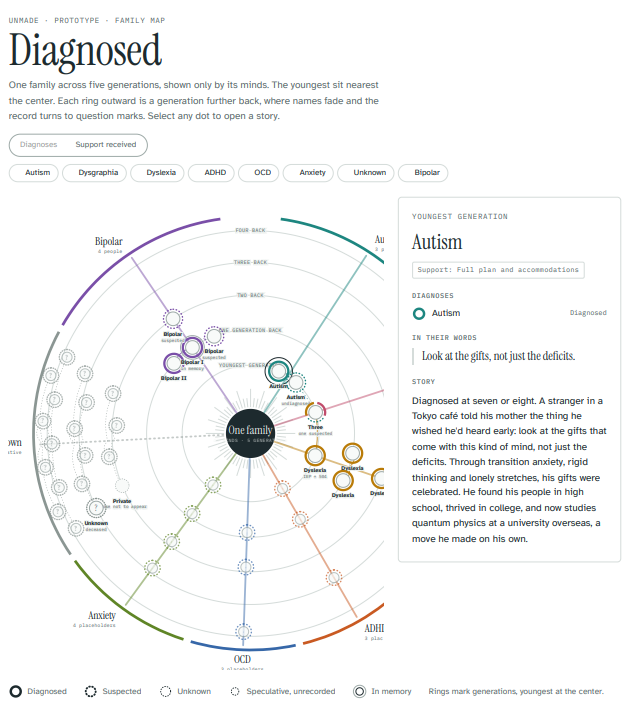
Each story will stands on its own, but will be mapped together to form a portrait of the whole family seen through its web of diagnosis such as bipolar, autism, dyslexia, dysgraphia and many other neurodivergent mental structures. It includes the diagnoses that are confirmed, ones we suspect, and ones we will never know as the members have been long dead. From this data storytelling genre of interactive documentary, the project will model the neurodiversity present in almost every, if not all, families. Neurodivergence isn't the exception in a family tree, it is the norm.
As someone with a neurodivergent mind in a family of neurodiversity, I offer this to others living with one or more diagnosises, confirmed or suspected. I offer this to families naviagting the stigmas and systems designed for attitudes and misunderstanding outdated from the learning over the past 30+ years. I offer this to society still deciding what to do with minds like ours, which holds brilliance, beauty, innovation and ingredients to the previous success and continued success of the human race; as well as the costs we need to learn to mitigate and support more effectively.
The Stories
Each node on the map will reveal real stories from the family members, diagnosed and not diagnosed. For example: A Café in Tokyo
A mom was sitting in a café in Tokyo when another American struck up a conversation, the way travelers do when they hear a familiar accent and looking for something in common. Eventually their conversation meandered to talking about their kids. She told him about her son who is on the autism spectrum. He was seven or eight then, and the diagnosis was new.
The man's daughter was already a teenager with the same diagnosis. He said the one thing he wished someone had told him when she was first diagnosed was to look at the gifts that come with this kind of neurology, not just the deficits. He had spent much of her childhood seeing her through a list of problems. It took years before he started to see and appreciate the incredible assets that came with this type of mind. She was brilliant, kind and talented in exponential ways. He regretted the years he couldn’t see it, and the anxiety and scarcity mindset that came with them.
She doesn’t remember his name, but she took what he said to heart and it deeply shaped the way she raised her son and honored his capacity. She spent a significant part of his upbringing managing his challenges, such as transition anxiety, rigid thinking and social isolation, but far more time helping to cultivate and celebrate his exceptional intelligence, creativity, curiosity, academic prowess and spiritual virtues. It paid off and continues. In high school he found his people and graduated with honors. In college he thrived socially and academically, living hours from home, on his own. Today he is pursuing his passion in quantum physics at a leading science and technology university overseas. Moving overseas on his own is a transition most “neurotypical” people would find hard to navigate.
The Map
The collection of stories and their related diagnosis are mapped to create a portrait of the family across generations of its neurodiversity. Pull back far enough and the macro view reveals the patterns of diagnoses like bipolar disorder that shows up again and again. Dyslexia that runs from grandfather, to sons, to grandson. Autism that seems to appear in some branches, and in others it's clearly present but never diagnosed.
Reading over generations the map also tells a story of progress. The older generations carry their diagnoses with almost no support. The younger ones get names, plans, accommodations and treatment their grandparents never had. The family tree shows how far we've come, and how recently. It also shows some of the positive older or culturally specific ways of including neurodiversity that have been lost in contemporary culture and wellness practices.
The map is also honest about what we know and what we don't. Some diagnoses are confirmed. Some are suspected by the people who love that person. Some belong to relatives who died before anyone had words for what they lived with, and where we can't know, we won't guess. Harm done is named as harm, not explained away by a diagnosis.
Every living person on the map decides how they appear: by name, anonymously, or not at all. Some places on the map will stay blank, and that's part of the picture too. No one can ever know every diagnosis in a family, and the silence that stigma creates is part of the story being told.
The Why
The man in Tokyo lost years of his daughter's childhood to a lens that only saw problems. Diagnosed is an offering to anyone at the start of that road, so they can look at the person and not just the label, sooner.
It is also a refusal of the word "atypical." When you lay out a whole family's brain structure and see it is echoed in most other families, there's no norm to measure against, only different leanings. Every mind tilts somewhere. Some of these tilts have given the world inventors, artists, physicists and people with a fierce sense of justice. Some have cost lives. Both are true at once, and the project holds them together without trying to resolve them.
The gifts don't erase the need for support. The brother's gifts didn't save him, whereas the research and treatment available today might have.
This family, my family, is not rare. We are ordinary.
Progress and Resistance
In a single generation, the understanding of neurodivergent minds has changed enormously in the United States and other countries or regions. The brother, my brother, who lived with Bipolar Disorder Type I, most likely had what is now recognized as a phenotype of bipolar disorder known as Thermoregulatory Sleep Dysregulation Disorder (TSDD). No one knew it existed while he was struggling. We didn't know that something as simple as living somewhere with milder, steadier weather could help keep moods even.
Today I serve on the board of the Children's Mental Health Resource Center, which works with families and supports research to understand, treat and destigmatize mood disorders like bipolar and TSDD in children and teens. If that help had existed thirty years earlier, my brother might still be with us.
School tells the same story. My father and brothers with dyslexia went through school with almost no help. My dyslexic son had an IEP and a 504 plan that opened doors my other family members never had. In evaluations at school and by psychologists that focused on cognitive and academic intelligence in areas not defined by the mechanics of spelling and grammar, he tested off the charts. One teacher, dyslexic herself, gave him a confidence in his own potential that was transformative, while others teachers discounted him completely.
That progress didn't arrive on its own. I had to fight for it, and some of the resistance I met was aggressively unjust.
In elementary school, teachers told me not to expect much from either of my sons (autistic and dyslexic). Both have proved them wrong many times over.
One school held up one of my son's IEP meeting for his entire kindergarten year. A teacher later told me quietly why: they hoped you would pull him out so he wouldn't drag down test scores and, with them, local property values. Between kindergarten and first grade, I spent $20,000 to help him learn only thirteen letters of the 26 in the alphabet, which should have been accomplished in school with the right accommodations.
My other son attended a charter school in second grade that basically admitted they couldn't afford to give him accommodations. After a year and a half of pushing for an IEP, a special education staffer told my that if I didn't stop being upset, she would hold up his IEP for another year. Another school read his IEP and placed him in classes for students with lower academic abilities. When showed his state test score that they were off the charts, they were shocked. They apologized they hadn't realized, he was "twice special."
A regional center claimed her autistic son didn't have autism at all, against ample evidence from doctors and therapists over a decade. A legal advocate later explained what was really going on when I sought an appeal. The center wanted to save its services for children it considered more severely impaired and push his support onto the school system by misdiagnosing him.
I was able to mitigated some of these kinds of challenges over time because I had resources and knowledge of the children’s rights to keep pushing back on the dismissals and divestments in my children. What about families who don’t have the information and resources? Parents told by a professional not to expect much from their child that believed it because it comes from a seemingly trustworthy source. What about parents facing language barriers, without money for tutors or lawyers, and were never told what their children were entitled to? The same lens the man in Tokyo regretted is still being handed to families every day, by the very systems meant to help them.