Magnum Opus
MAGNUM OPUS follows a composer's journey to create the greatest work of their life and the discovery, through the masters, mentors, and lessons, that mastering music means mastering life, and that the truest composition starts with the heartbeat.
Origins
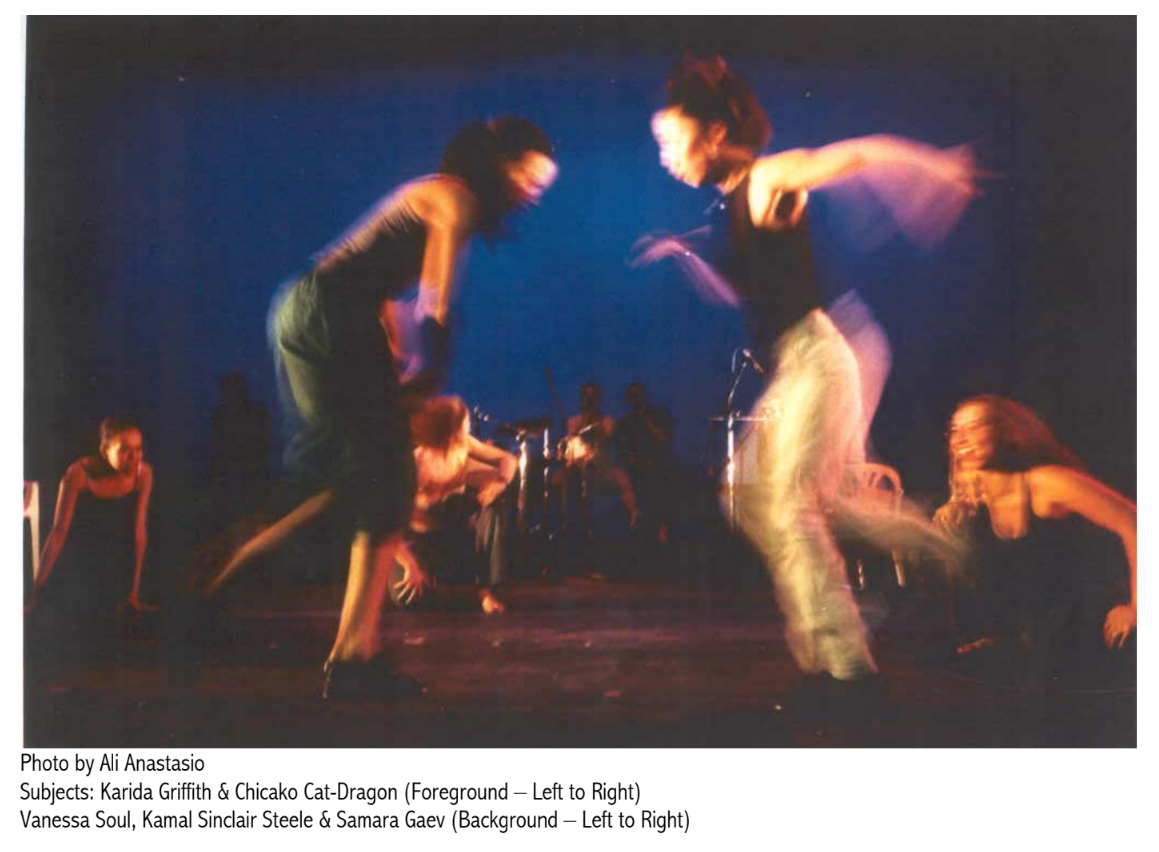
In 1998, when The Beat premiered at Context Studios, as a production of Fractured Atlas, Hip Hop Theater was not a term yet, but the show was a pioneer of the genre along with shows like Bring in ’da Noise, Bring in ’da Funk, Rennie Harris’ Puremovement, Jam on the Groove, and Def Poetry Jam.
Kamal’s vision was to create the first theatrical work of magnitude to establish hip-hop as “high art” and to reinvent “high art” as hip-hop. Symphony, ballet, prose, choral song, and abstract visual art combined with, or reinterpreted by, the inventions of hip-hop: hip-hop composition, breakin’, spoken word, DJing, freestyle, beatbox, and graffiti. The protagonist is a metaphor for hip-hop itself: a child of classical and jazz music in search of acceptance, taking the same journey into maturity that every established musical genre has traveled.
Two Versions
MAGNUM OPUS is the renamed and expanded form of THE BEAT, the stage work created by Kamal Sinclair. The two share the same story spine. THE BEAT premiered as a Lower East Side work-in-progress in 1999, matured through New York runs in 2000, and traveled to Southern Africa in 2001, and San Francisco in 2003. By December 2008 the work was being pitched under the title MAGNUM OPUS.
A multi-platform instinct was present from the start and in 2004 Kamal envisioned a cast album, music videos, concert tours of the orchestra, and merchandising beyond the run. The live show would be a foundation for building a brand culture and a platform, not only a production. In 2009, with the dawn of what came to be known as Transmedia, Kamal developed a project design that encompassed the experiences of story and music culture were changing with interactive and social media platforms (aka Web 2.0).
The Composers journey is spine the stage play and the transmedia experience shares. The two forms part ways on who the protagonist is. In the stage play the protagonist is fictional: a young, orphaned composer who functions as an allegory for hip-hop coming of age.
In the transmedia experience the protagonist is real: a beloved mid-career or veteran musician whose actual search for a career-defining work the public follows and helps create. The transmedia version is therefore less an adaptation of the play than a real-world project built on the play’s architecture—the journey toward one’s magnum opus, the “music theory / life theory” lessons, mentors who function as Guides, and a culminating, conducted concert.
V1 - Theatrical Production
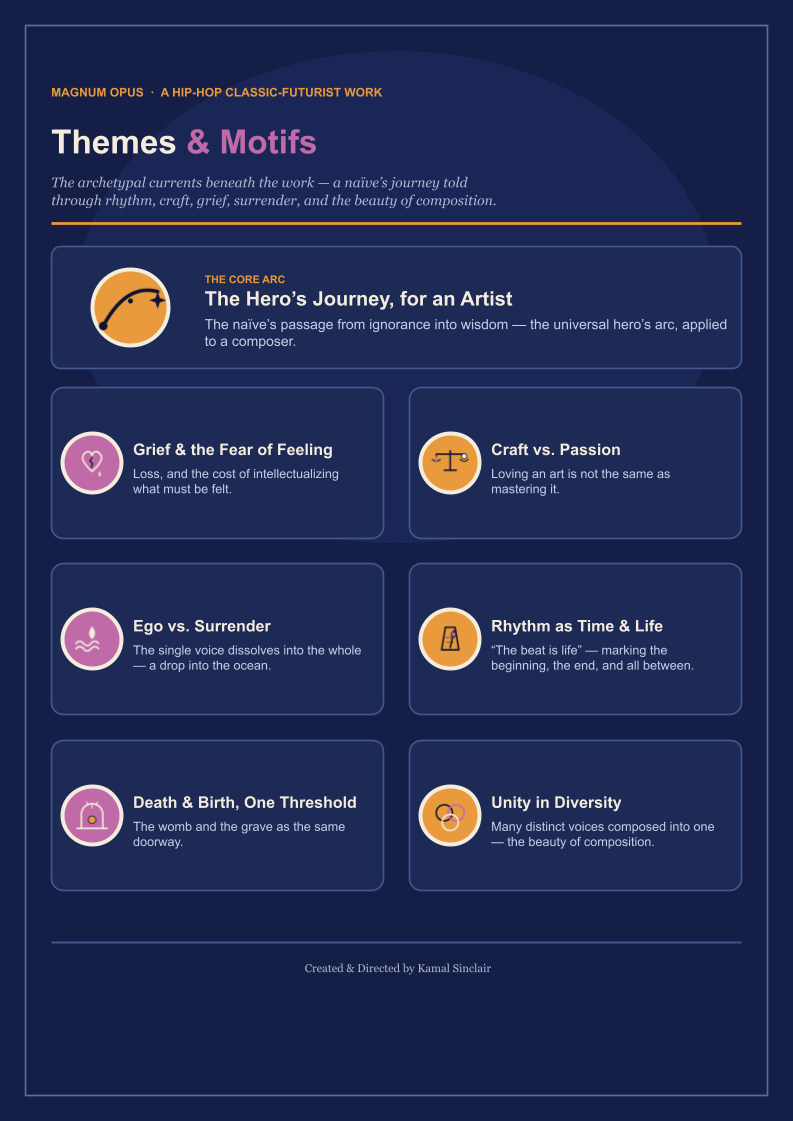
MAGNUM OPUS is an ancient story of the naïve’s journey into knowledge. A young composer’s journey starts in the Valley of the Beat, a club in the East Village of Manhattan (a combination of the Nuyorican Poets Cafe & SOBs) in the late 90s. His desire is to join the ranks of Bach, Mozart, Coltrane, and Davis, only his chosen genre is hip-hop, because it has no limits, is universal, and can sample from and reinvent any kind of music.
Born in the 1970s as the seeds of hip-hop were sown in the streets of New York, he is a child of Harlem: his father a jazz drummer, his mother a classically trained cellist. Their love of music distilled into a phrase his father spoke after every gig - “The beat is life.” They died when he was still young, before achieving their own magnum opus, leaving him the seed of musical love but no guidance, and a calling to finish their work he does not know how to fulfill.
As the story opens, he is trying to realize the music latent in his soul while harboring deep fears of its power to unlock loss, bitterness, and anger at death, keeping that power at bay by making music an intellectual pursuit and everything he makes is stale. One night in the Valley of the Beat, two emcees perform a piece called The Beat with a full band. The music comes to life in his mind in intricate layers of composition. He imagines that each instruments’ sound is perfectly illustrated by a dancer, each dancer is influences by a different dance form; virtuoso tap, modern, African, hip-hop an more. Seeing all the dancers’ choreography at once shows the beautiful and complex layers of the music. This experience pulls him into a metaphysical valley beyond the club, similar to the rabbit-hole pulling Alice into Wonderland.
There the Composer meets characters who teach him fundamental lessons of music theory, which are metaphors for life theory. He fuses classical, jazz, and hip-hop; debates music theory; improvises with the orchestra; falls into trance through Afro-Haitian ritual; fails publicly and is challenged to be better than he believed he could be.
He witnesses musicians fearful of their own power learning to let go of their ego and become vulnerable enough to share their heart and soul on stage. He learns that the power of the symphony is music made absent of ego, as their individual contributions are almost indistinguishable in the blend of the many seem-less contributions. He meets players who have lived both the power and the pitfalls of the beat.
Finally the Muse brings him to the threshold between the physical and the metaphysical, where he releases his fear and reconnects with the spirit of his parents. Listening to his own heartbeat, he realizes its rhythm is his parents’ greatest composition, their magnum opus, and, using that heartbeat as his metronome, he conducts his own.
Stage Production
The stage play is a completed, full-length theatrical production: a fusion concert-drama in which an orchestra, a dance company, emcees, and a single protagonist move through thirteen scenes inside the transforming world of the Valley of the Beat. All dialogue is delivered as rap or spoken-word poetry. It runs approximately one hour and forty-five minutes.
V2. Experience Platforms
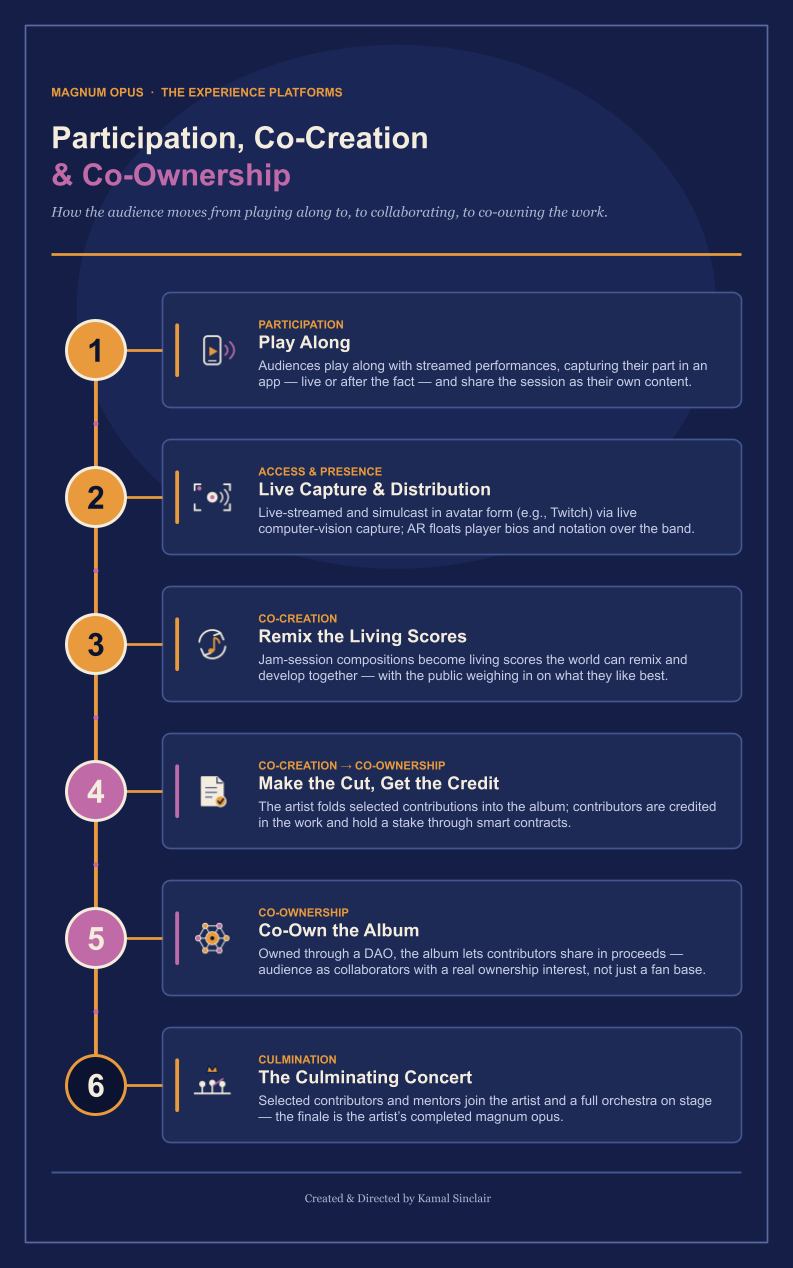
MAGNUM OPUS, as a transmedia work, is a participatory music-creation project: a collaboration between a known and beloved musician and the public. Over a multi-month process the public follows, contributes to, and sees transparently a mid-career artist’s journey to compose their magnum opus. The result is a non-linear album that is co-owned by the contributors from the public through blockchain mechanisms such as smart contracts and a DAO.
Across the process, audiences gain access to the artist’s jam sessions, lyric book, and journal, and to the artist’s conversations with the people who shape them such as, veteran musicians, everyday people with something to say, and cultural legends. The public has a view into, and a dialogue about, the life lessons, struggles, inspirations, experiences, and stories of the artist’s creative process. It is the play’s “music theory / life theory” made literal, with the audience cast as co-creators rather than spectators.
The project is national in scope. The artist tours multiple cities, playing with each city’s music communities and mentors, and the journey builds toward a culminating concert and album release at a major performing-arts hall (similar to Lincoln Center, The Music Center, or Carnegie Hall).
The project is envisioned as recurring—an annual or biannual cycle that supports a different artist or band each time in developing their next major work, at a scale comparable to a marquee artist tribute mounted by a major cultural institution.
Core Elements
National Tour - The artist travels city to city, jamming with each city’s music communities and mentors across genres (jazz, hip-hop, salsa, country, and more).
Behind-the-Scenes Documentary Series - An artful series (not reality TV) following the artist’s conversations and creative process on the road; envisioned for release online or with a film/production partner.
Interactive Moleskin Journal - The artist’s digital journal—doodles, composition notes, lyrics, philosophies, epiphanies, stories—opened to the public so they can be inside the artist’s head.
Online Lyric Composition Book - Lyrics published online and annotate-able by the public, in the spirit of a Rap Genius layer of commentary and meaning.
Geo-aware Feature - Location-aware functionality tying the experience to places on the tour and to where audiences are.
Casting the Protagonist
The transmedia protagonist is a real, charismatic musician with genuine chops—ideally one who can play and who is also a strong constructor or composer of other musicians, not only a soloist. The intended register is a mid-career artist being mentored to the next level, though a veteran in conversation with peers could work equally well. As archetypes of the caliber and charisma in mind: a young Prince, Pharrell, or an Alicia Keys—named only to convey the level of talent and presence, not as casting.
Magnum Opus © 1998, 2001, 2010 - Written and created by Kamal Sinclair