BLUE
In this world lived a woman named Blue. Her culture was conservative. Bearing a child out of wedlock was deeply stigmatized, and women who did were shamed. Not outright. People smiled at them and hugged them, but there was always pity, quiet conversation, and the cautionary tales passed from mothers to daughters, generation after generation.
Those were the tales Blue was told as a young, impressionable girl. She was a nice person, and so were her parents and everyone around her. The culture told these stories to protect girls from that shame.
She earnestly wanted to be a good girl, and to grow into a woman of virtue. She was confident in her good character and steadfast morality that she knew she would be married woman before becoming a mother. Undoubtedly!
She pitied those who had fallen from grace. Growing up, her friends shared her pride in being virgins. Then a few of those friends fell. Blue loved them, stood by them and supported them. But she was in the quiet conversations of pity and judgement and felt sorry for her friends for not being strong enough to maintain their virtue. Being part of those whispering made her even more stalwart about being one of the good ones who did it right.
But life is life, and people are people, and she experienced all these variations and dynamics of love, attraction, intimacy and closeness. Because Blue believed she would never be one who fell, she never prepared to protect her fertility. Preparing meant she was willing or expecting to waiver in her morality. She thought herself impregnable before marriage. She had a high opinion of herself.
The Child
Then, in a time that she was not so young and not so old, she found herself with child. Not with a husband. Not in a meaningful relationship. With child.
The shame came at once. Every lesson of her girlhood rose up in her. She had been the one who pitied, and now she was the one pitied. She had become the cautionary tale.
Beneath the shame, something else stirred: her connection with the child in her belly. It was indescribable, a soul tied to hers. She loved him. But love did not quiet the shame. It only made it harder to understand.
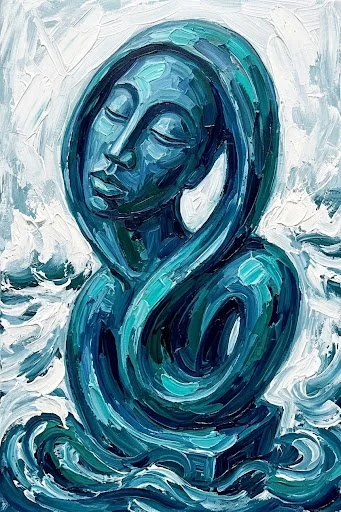
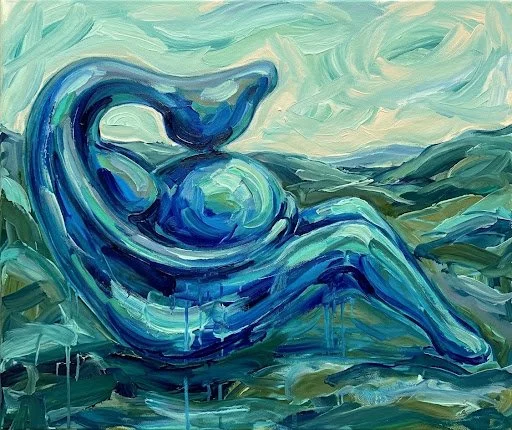
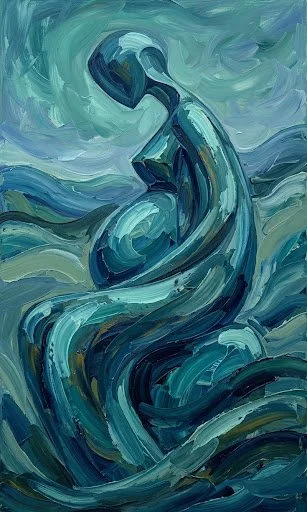
Her belly was beautiful, shaped almost like a teardrop. Her curves were so smooth and articulated they could have been carved from onyx, or from the soapstone like a Shona sculptor. And so blue. However her belly was visible proof of her immorality. This protruding and prominent shape, however beautiful the curves, meant that unlike other moral indiscretions of people in the community, hers had nowhere to hide.
But the time came and passed, and the child did not. Another nine months passed, and another, and another. People whispered that it was a curse for breaking the rules, and Blue believe them.
Ten years passed, and every day she faced it again. The smiles that did not reach the eyes. The hugs heavy with pity. The conversations that stopped when she walked in. Her old friends who shared her virgin pride now married mothers looked at her with sorrow. Over and over and over. She withdrew from the community she grew up in, and it let her go.
The Doula
In those years, Blue reconnected with a long-lost friend. In their years apart she had become a doula and grown adept at the role. She was younger than Blue, not an elder, but still very wise. She genuinely held no judgment. She understood the spectrum of love and all the ways children come into the world and are cared for: by a single parent, a village, two parents, a multigenerational home. All the ways a child can be loved, taught, kept well and supported into its own maturity.
She was the first person in ten years to look at Blue's belly with respect and love, not pity.
For ten years Blue had felt contractions come and go, and none had brought her child. One day the doula asked her, "Are you afraid to bring this child into the world?"
Blue sat with the question and realized she was. She was afraid he would be born marked by her shame.
The doula said, "While the baby is inside you, you can protect him, and you feel safe in that. Once he is in the world, your protection is different, and far more vulnerable. But this child needs to come into the world. He wants to be here. You can keep loving him, protecting him, nursing him at your breast. But it is time for transition."
Then she asked, "And the shame. Whose is it?"
Blue had no answer. The doula told her the shame was never hers. It was handed to her as a girl, in stories told by people who loved her and were afraid. It belonged to a world that can see only one shape of family and one shape of goodness. Her child was not a curse and not a punishment. He was a child, and he was loved. That was all he had ever been.
Blue had carried the whispers so long she had mistaken them for her own voice. Now she heard the difference, and she set the shame down.
The New Color
Blue rose. The contractions came, her body opening and closing, opening and closing. She saw a mandala in the painting like space before her unfold, and she relaxed into its turning kaleidoscope until, slowly, she released her son. She felt the most joy she had ever known.
The child of Blue brought a new color into the world: a warm, shining color. He blended a brilliance into the painting-like environment that is hard to articulate.
She returned to live in society with her child. The whispers did not stop, and neither did the pity. But they no longer landed. She felt liberty and serenity she had never had as a good girl.
She started to feel sorry for those who whispered. They were still trapped in the fear of falling from grace, ruled by an oppressive of limited understanding of morality. They were the true cautionary tale. Having fallen from grace, she was free, and in that freedom she found a gentler and more loving God.
The Form
The story is told through a box of small paintings rendered entirely in shades of blue. Each painting captures a moment or image, and on its back is written a portion of the story. Readers lift the paintings from the box one by one, looking at the image and then turning it over to read the words beneath. The narrative unfolds in fragments, held together by the box and by the single color that runs through every piece.
The World
This story is set in a world that is undefined. It is not this world, and not an alien world on some far-off planet. It is not the microscopic unknown or the deep ocean, and it is not a magical fantasy world. It is a world that exists as if in were in a painting.
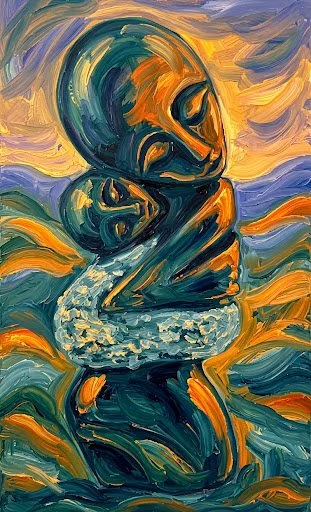
Everything looks like fluid brushstrokes in blues, teals and greens. Everything carries some hue of blue. But the world is not flat like a canvas. It is deeply multidimensional. People's bodies are in three dimensions and have six degrees of movement, yet they blur into the landscape, as if their tunics and dresses, lacks and skirts flow into the rolling ground. There is no separation.
Yet the world is as practical and pedestrian as ours. People have occupation, families and community, all the things that make a life as we know it.