

Graveyard Portraits
This idea for a large scale photography and story book began on a sunny, coat-cold autumn morning in a California cemetery, on a walk taken for no reason other than the quiet.
On one stone: a husband and a wife, a marriage that would have had its prime between the fifties and the seventies, she considerably younger, and outliving him by twenty years. His side carried a cross. Hers carried a Star of David. A single glance held a whole life's worth of questions. Who were they? What had they negotiated between them? What did she do with those twenty years alone?
This book is an act of attention paid to the markers of a life created by those who knew them, had relationships with them, or who simply had the job of creating context for those without people to define them on a headstone.
Each spread pairs a photograph of a real grave with a story invented from evidence alone such as the name, dates, inscription, shape and weight of the stone, neighbors buried close by, surnames that repeat, the arithmetic of who outlived whom, and the particular feeling of standing in that place. Turn the page and the actual life appears: the obituary, the record, the person as they were. Between the two sits the honest gap between what assumptions we can make of a stranger by the most consequential marker of a life lived, their gravestone and what was true from the records they left to history.
The book opens and closes with my observations of the cemetery's activities over days and weeks and holidays. Perhaps there are uneven populations, the newer sections busy with weekend visitors while the older rows sit unattended.
Background
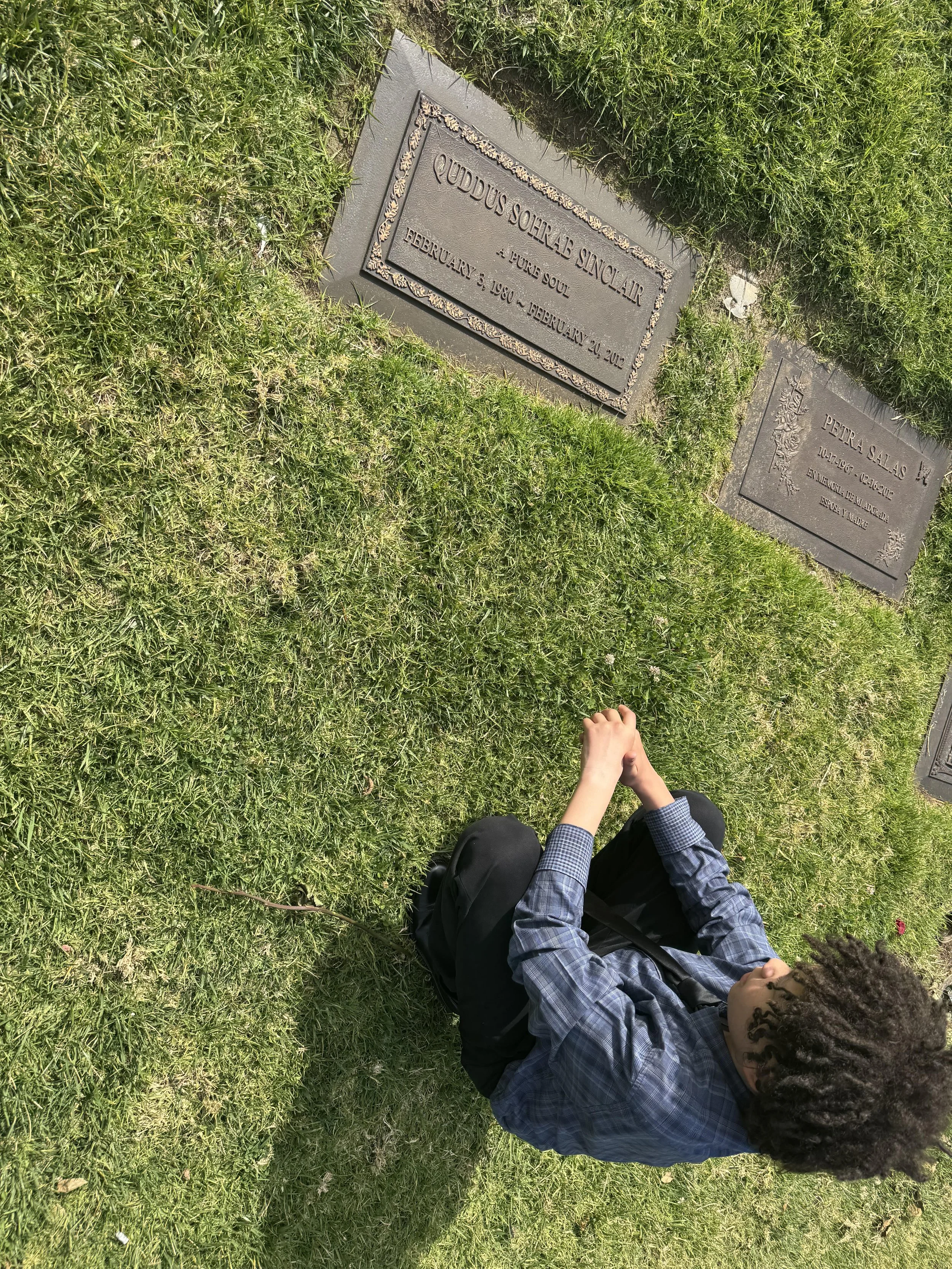
A Pure Soul
My younger brother was a big, beautiful, bright light. The words I keep reaching for to explain how beautiful he was are ridiculous clichés — both very true and very inadequate to communicate how beautiful, kind, joyful, wondrous, and mesmerizing he was. But to write a few thousand words explaining his character and his virtue and the deep, profound ways he affected the hearts of others wouldn't be right either. Simplicity is somehow essential to any attempt to describe him.
As you can tell from this paragraph alone, I was not the one to find the words for his marker. When I went to his grave months after the funeral, to say prayers and sit with him, I found the marker my other brother Robert had made. A simple stone that said:
"A Pure Soul."
It was perfect.
I wonder if the people who walk past his grave stop to consider who this person was — Quddus Sohrab Sinclair, born 1980, died 2012 — and what it means that these were the final words chosen for his resting place. I wonder whether the context of place, time, name, and that last definition of a soul gives them any inkling of who he was. Do they need to know anything more than that his family, his loved ones, and his community said he was a pure soul?
This makes me curious about this ritual of storytelling. This project lets me explore that curiosity.
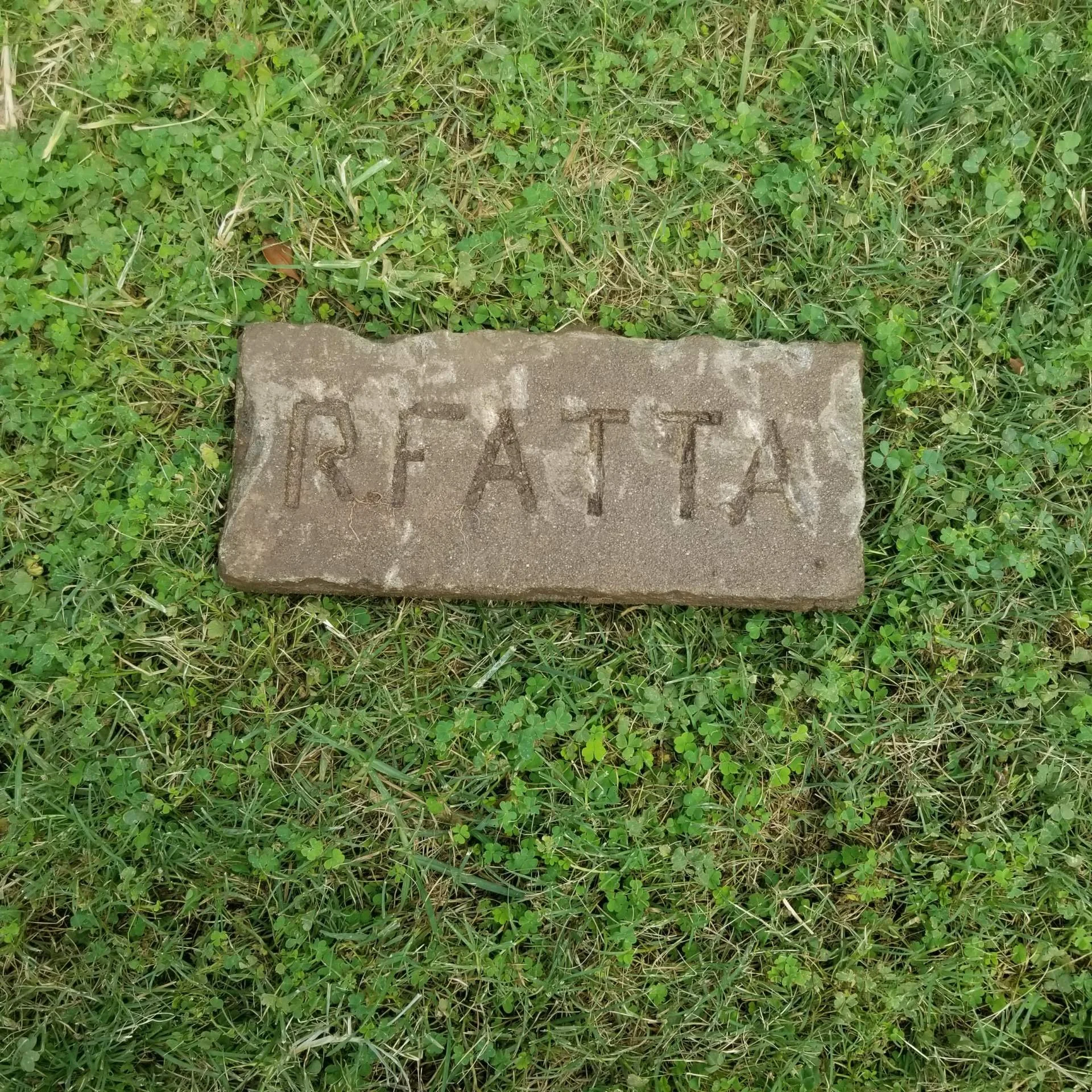
Portrait Example
Six letters & a period
R. FATTA is a person whose people, or the people charged with creating their marker, thought their grave stone should simply have:
the initial of their first name,
a period,
and the five letters of their last name,
in all capitals
They thought this was a fitting way to give people in the future enough context to understand this person.
I discovered this gravestone at a small cemetery in Altadena, California. R. FATTA is buried in the place as my dear friend’s mother, who was also a friend, a novelist whose books have deeply impacted my life and culture, and a scientist whose work had deep-ploughing consequences for the physics of elementary particles and helped create atomic warfare. Did R. FATTA live during the same time as these three people? There are no dates on their stone. Was R. Fatta a man, woman, non-binary person? Did they live here or were they brought here after death? Did they love someone? Did someone love them?
The stone is small, simple, and crudely chiseled, but beautiful in its simplicity.
The Quiet Life
Perhaps R. stood for Rowan, or Rosa, or Reuben. Perhaps they arrived in Altadena on a rattling train from a distant coast, seeking the dry heat to heal a pair of weak lungs. Or maybe they were born right there in the valley, their hands perpetually stained with the scent of citrus and eucalyptus from the surrounding groves.
The air in Altadena carries the scent of dry sage and dust from the San Gabriel Mountains. Fatta lived a life of quiet routines, walking the dusty paths at dawn, listening to the mockingbirds, and sharing quiet evenings on a porch that looked out over the sprawling basin.
The dust of the Great Depression settled heavy over Altadena in the early 1930s, but along North Lake Avenue, something defiant was taking root.
In 1930, the schoolchildren of Altadena were given a rare bit of agency in a world suddenly defined by what they couldn't have. Offered the choice between a swimming pool and a tower for their new junior high school, they chose to look up. They picked the tower. When Eliot Middle School opened its doors in 1931, Fatta was one of those children. She loved standing at the top of the tower to see the valley with citrus groves and avocados trees for miles. The swimming pool would have been nice, since it is warmer here than other parts of LA County, but the view was good for the spirit.
Her favorite class was agriculture. In an era when the nation's economy was in freefall and hunger was an epidemic, she was fortunate to live in a place where food grows in California sun in the fertile soil of the San Gabriel foothills. That saved a lot of people in her community from being desperately hungry, so she decided to be a planter, grower, agricultural expert.
Her real classroom was the citrus grove.
She coax life from the dirt. She learned to graft a sweet orange branch onto a hearty rootstock. She was a constant gardener. She knew that a child who learns to tend a sapling through a drought is a child who learns they, too, can survive hard seasons. So she became a teacher at Eliot Middle School as an adult, teaching agriculture, home economics, and other survival skills.
In 1969, when her time came early and she was laid to rest in that small foothill cemetery, the world had changed. The crude, simple stone that marks her grave was carved by her father who was illiterate and didn't have the money for polished granite or elaborate epitaphs, but who had a chisel, a stone, and a deep, enduring love.
R. FATTA
Simple, grounded, and unyielding, just like the trees he taught her to plant. And it was enough.
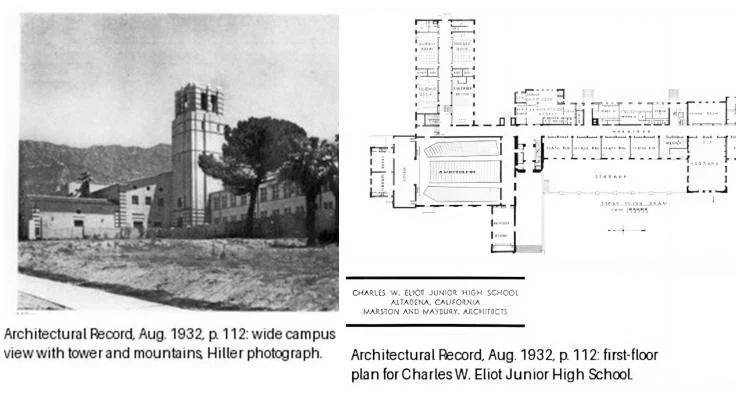
1931 image of Charles W. Eliot Junior High School
Gasper’s Kin
I haven't yet found much on R. Fatta.
The Mountain View Cemetery records give the name as Rosina Fatta, died January 7, 1915 — two years after Gasper Fatta, whose grave lies a few lots away. I don't have details of her life. I do have details of the year and the place she died in.
Fatta is Italian, derived from fatto: done, made. It is likely occupational, attached to someone in a trade that produced something — a craftsman, an artisan, a maker.
Italians had been arriving in Southern California since the 1820s, settling first in Los Angeles, where they met less hostility than their counterparts on the East Coast. They built the agriculture and the viticulture, brought crops and wine-making methods that reshaped the region, and by the late 1800s had established enclaves and businesses of their own.
Altadena in 1915 moved at a leisurely, sun-drenched pace, scented with citrus bloom and backed by the San Gabriels. Affluent residents and health-seekers built sprawling Craftsman estates designed to dissolve the line between indoor living and foothill air. Days went to private orange orchards, garden parties, the open-air trolley down to Pasadena for a concert. Weekends went to the canyon trails, or up the Mt. Lowe Railway to the alpine resorts. It was a tranquil, semi-rural haven whose residents cherished their privacy and their landscape, set safely apart from the noise of Los Angeles.
On the day she died, Kaiser Wilhelm approved the strategic bombing of Britain.
Altadena's politics that year were a grassroots campaign to stay independent — to protect its rural charm and its tax base from Pasadena's advancing borders. With no municipal government, the unincorporated community ran on elite civic Improvement Associations, where estate owners and newly enfranchised women lobbied Los Angeles County for favorable zoning and roads. The dominant fight was a resounding rejection of both annexation and incorporation; residents feared that local governance meant commercialization and higher taxes. Instead this wealthy, overwhelmingly white electorate used its financial weight to secure water rights, restrict industry, and preserve a secluded sanctuary built for luxury residential living and mountain tourism.
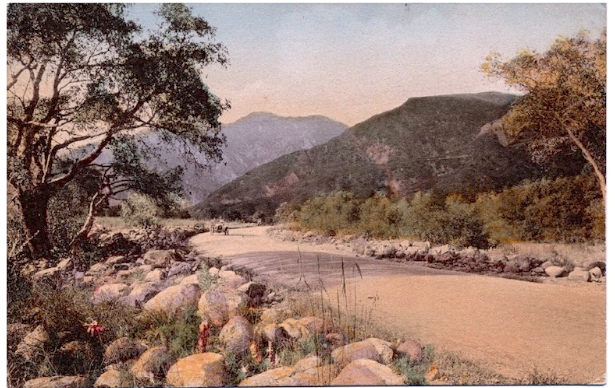
1915 Postcard – Altadena Drive north of New York (Altadena Historical Society)